Showing posts with label students. Show all posts

Wednesday, March 14, 2012

Addition to Teaching Tip #35


They know each other well. Even if you understand how they learn, they still see things from a peer's point of view which is essential to learning. And "differentiating" your lessons to appeal to all is EASY when you roll with the punches and go with the flow of their mindsets. And the feedback may produce more positive results.

Today, in a different class than from #35:

Most of class: "All I see are triangles.  I can't figure out what you're doing."

Student [Who should be a teacher]: "You need to do it in different colours like in the book."

*I do it, which helps, and I continue but while they see it & follow me, they don't understand how to get there*

S: "Do it like the book, with the letters."

*I feel dumb, knowing that this class loves to do letters, and forgetting.*

Me: "The problem is that I have to grayscale it for the review and test."

S: "highlight it then or colour it because they can't see it otherwise."


I know this class.  I know that they love colours and do have trouble visualizing things that aren't in front of them.  I felt very slow and not with it today.
And you know what?  I know I'm going to go through 20 review packets and 20 tests and highlight the figures for dilations.  Because while they understand the difference between P and P', they can't determine scale factors without understanding which colour. 

Wednesday, December 14, 2011

Teaching Tip #35

Listen to Your Students

Listen to them, and take their ideas into consideration.  Don't just ignore requests and tell them, "It's my way, deal with it."  This is a paraphrase of what happened yesterday:


(Note: S# stands for student)

S1: "Okay, so I have a proposition."

Me: "Go ahead."

S1: "OK, so...you know how tests are cumulative but we forget things?  How about you do cumulative quizzes every week instead, and make the test just for that chapter or section."

S2: "No, because what if we fail the quizzes?"

Me: "Well, I always go over them, you know that."

S1: "And it wouldn't matter since it would come up more often, and we'd get more grades.  So the one failure wouldn't even count."

Me: "That wouldn't mean you wouldn't have quizzes on the material we're learning."

S1: "No, I know. But I still think it would help us."

Me: "We'll try it in January."

S2: "OK, trial. But if it doesn't work, can it stop?"

Me: "We'll start this in January, but I do think it's a good idea."


And I do think it's a good idea - for all my classes!

Sunday, October 30, 2011

Teaching Tip #24

Write Down Notes

It's one thing if you're a college professor in a class where lecturing to the students without writing anything down is the norm (like maybe a history class).
 It's another thing to do it to high school sophomores who are learning Eastern Civ and don't know spellings or names or dates and have never been exposed to a lecture and have difficulties keeping up with your verbal notes.

I've learned from my teacher's mistake - I almost always write down notes.  Even if I wasn't teaching math, I would do it.  Some students really need to see what's going on. Lecturing and expecting everyone to keep up with you and get the spellings down the first time you say them doesn't work out well when you're teaching a class with students of various learning abilities.

It helps the slower students keep up and the visual learners to understand what's going on.  I have a few students who read what I put down before writing it because they comprehend better that way.

Teaching Tip #22

Allow Group Work

Again, this goes along with my past few posts.

I know that there are multiple studies which say that group work should be done almost all the time and you should have a strong learner, a low learner, and two medium-level learners.  Sometimes this really does work.  in one of my classes, two of the lower learners work better with one of the stronger students, and I allow the three of them to work together whenever there is group work.

I don't think group work should be done all the time, but 1-3 times a week, depending on your time and activities.  The students need to interact with each other, whether in pairs or a small group.  Not only will they learn more in the end (for some reason, peers explain things better than teachers, even if they're saying the same thing), but it tends to create a more relaxed environment. 

Lay down the ground rules from the start.  Something I've found myself repeating often this year (becauase I had some problems last year) is that if I hear them getting off-topic and if they don't work, then they all have to do the work independently.  I walk around the room and help out the groups and individuals.  Because of the groups, it's a little less work for me - but I still have the one-on-one time with them.

Don't force it.  If a student says they work best independently, don't tell them they ABSOLUTELY MUST work with someone else.  If they're struggling with a concept, see if they would like to work with a classmate, but don't force it.  that will make them lose trust in you and may make them less apt to do the work.

Tuesday, October 25, 2011

Teaching Tip #21

Let The Students Talk

I know a lot of teachers have a problem with this, but let me be clear: my students know that if they start talking about something outside of the classroom, something not related to the class, I will make them work independently/make it silent.  They don't want that and I don't want that.

The main thing is that you have to be very aware of the conversations.  Is the whispering about a clarification on the notes that I'm moving on with, or is it about the English paper that's due tomorrow?  The former conversations should be encouraged; the latter not.

I discovered my desire to be a teacher by helping my classmates during group work, but sometimes students need reinforcement before work is done.  Their classmates/friends can explain things differently than I do, which may get through to them.

Whispering is also different than talking; working with the person next to or behind you is different than asking your friend who's sitting across the room a question.  Set the rules/guidelines immediately and follow through with consequences.

But let them talk.  It will result in less confusion later on.

Monday, October 24, 2011

Teaching Tip #19

Incorporate Pop Culture

This goes along with #18.  If the students like a show, movie, music group or book, use it!  You will never know what you will find yourself enjoying.

When I was student teaching, I did a probability lesson on Taylor Swift songs.  My 8th graders went ballistic - and I discovered that I enjoy her music.  I had never listened to her before.

If your curriculum/supervisor/principal allows you to, swap a "usual" book students have to read for one that is more recent and/or they may like more that has the same theme(s). 

Sing songs to get their attention, quote from movies, and mention things on tests and quizzes.  The quirks show the students you care and that you're actually paying attention to them.

Teaching Tip #18

Make Things Relevant

No matter what the class, even history, you can make things relevant for the students.  Don't stick with the same boring word problems the books have been using for eons.  Change the names/ places of things that makes the students want to participate.  Give them writing assignments they'd actually enjoy. have them do a small project on the history of their favourite TV show or movie.

The possibilities are endless, and the more students recognize that everything can relate to their lives, the more apt they will be to actively participate (and maybe enjoy) the material.

Wednesday, October 19, 2011

Classroom Examples

From an activity on scientific notation & animals when I was student teaching.

Student work when I was on a long-term sub position

A mixture of colour, song lyrics (from Fireflies by Owl City), and comics

I like throwing in Star Wars whenever I can.

My Pre-Calc students did an activity with unit circles and paper quilts.

Colour, Star Wars, and books!

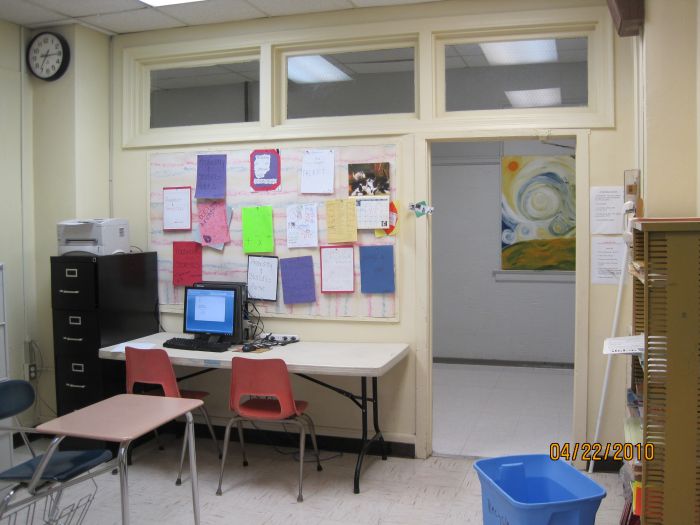
An example of my classroom from the back at the start of the school year.

Monday, October 17, 2011

Teaching Tip #5

Be Aware of Non-IEP Difficulties

Just because a student doesn't have an IEP (or even if they do), it doesn't mean they don't have [other] problems.

Some of my students have trouble seeing the board, so they get priority seating.

A lot of my students have difficulty reading long things because words blend together.  I italicize or bold key points on quizzes and tests because of this.  I also offer a separate paper to cover the other problems so that they're not overwhelmed.

Teaching Tip #4

Read the IEPs

They will help you understand the students better and will help you adapt your lessons (and seating). If you have opportunities to provide alternative assessments, you will know who will benefit most with certain targets.

For example: If a student is a great artist but bad at writing, have them draw out a variety of scenes to describe how they interpret something.

Or if a student verbalizes well but can't write thoughts down, have them take the test orally with you at the end of the day.  Give them tips on how to write their thoughts.