Get The Students Out of the Classroom
I don't mean to take them out on the roof, but again, do something a bit different. If you're teaching science, do a lab outside. Collaborate with another teacher (if possible) and have your classes do a project together. Take advantage of the library/media center/computer lab (whatever your school has to offer) and get the student doing research - papers, PowerPoints, Excel documents....
These things should (of course) be relevant to your class and the topics you're teaching, but like I mentioned in my last post, doing something out of the norm will hopefully spark something in them that will allow them to remember the topic and class.
Showing posts with label activities. Show all posts
Showing posts with label activities. Show all posts
Monday, November 7, 2011

Teaching Tip #28
Get The Students Out of Their Seats
Students don't want to sit there all period and be taught to and I'm sure you don't want to stand there and teach for 40-90 minutes. Get them up and doing work on the board, allow them to move seats into groups - and shoot, give THEM the opportunity to teach sometimes! Activities are great no matter the age nor the class, and doing something different means that they'll be more apt to remember your class - and the work they did in it.
Students don't want to sit there all period and be taught to and I'm sure you don't want to stand there and teach for 40-90 minutes. Get them up and doing work on the board, allow them to move seats into groups - and shoot, give THEM the opportunity to teach sometimes! Activities are great no matter the age nor the class, and doing something different means that they'll be more apt to remember your class - and the work they did in it.
Sunday, October 30, 2011
Teaching Tip #22
Allow Group Work
Again, this goes along with my past few posts.
I know that there are multiple studies which say that group work should be done almost all the time and you should have a strong learner, a low learner, and two medium-level learners. Sometimes this really does work. in one of my classes, two of the lower learners work better with one of the stronger students, and I allow the three of them to work together whenever there is group work.
I don't think group work should be done all the time, but 1-3 times a week, depending on your time and activities. The students need to interact with each other, whether in pairs or a small group. Not only will they learn more in the end (for some reason, peers explain things better than teachers, even if they're saying the same thing), but it tends to create a more relaxed environment.
Lay down the ground rules from the start. Something I've found myself repeating often this year (becauase I had some problems last year) is that if I hear them getting off-topic and if they don't work, then they all have to do the work independently. I walk around the room and help out the groups and individuals. Because of the groups, it's a little less work for me - but I still have the one-on-one time with them.
Don't force it. If a student says they work best independently, don't tell them they ABSOLUTELY MUST work with someone else. If they're struggling with a concept, see if they would like to work with a classmate, but don't force it. that will make them lose trust in you and may make them less apt to do the work.
Again, this goes along with my past few posts.
I know that there are multiple studies which say that group work should be done almost all the time and you should have a strong learner, a low learner, and two medium-level learners. Sometimes this really does work. in one of my classes, two of the lower learners work better with one of the stronger students, and I allow the three of them to work together whenever there is group work.
I don't think group work should be done all the time, but 1-3 times a week, depending on your time and activities. The students need to interact with each other, whether in pairs or a small group. Not only will they learn more in the end (for some reason, peers explain things better than teachers, even if they're saying the same thing), but it tends to create a more relaxed environment.
Lay down the ground rules from the start. Something I've found myself repeating often this year (becauase I had some problems last year) is that if I hear them getting off-topic and if they don't work, then they all have to do the work independently. I walk around the room and help out the groups and individuals. Because of the groups, it's a little less work for me - but I still have the one-on-one time with them.
Don't force it. If a student says they work best independently, don't tell them they ABSOLUTELY MUST work with someone else. If they're struggling with a concept, see if they would like to work with a classmate, but don't force it. that will make them lose trust in you and may make them less apt to do the work.
Tuesday, October 25, 2011
Teaching Tip #20
Sing &/or Dance
I'm serious. Even if you're a bad singer, as long as you're not tone-deaf, they'll get a kick out of it. Until you start singing along with them. Usually at that point they'll stop and tell you something along the lines of, "No. It's not cool when you do it."
Well, you got them to focus on you.
I do it for a few reasons. I began to do it while student teaching to cut down on talking. That backfired and resulted in 8th grade boys standing on their seats and singing in one class. In another class, I got the above response and the singing stopped and attention was on me.
I sing now for prayer (I work in a Catholic school, and it's just something different) and to get their focus. I sing real songs and made-up songs - like "And the limit approaches infinity, huzzah, huzzah" (to the tune of "The Ants Go Marching."
Sometimes along with my tunes I do a little "dance." Again, it's a focusing agent but it does sometimes backfire.
As with all things, don't do it too often, else the students will stop responding to it. But if you're doing it for fun, then go ahead. Students like to see that their teachers are people too (as weird as that may sound).
(I mean...at a family night my girls taught me and about 1/3 of the faculty to two-step to a club song. They got a kick out of it.)
I'm serious. Even if you're a bad singer, as long as you're not tone-deaf, they'll get a kick out of it. Until you start singing along with them. Usually at that point they'll stop and tell you something along the lines of, "No. It's not cool when you do it."
Well, you got them to focus on you.
I do it for a few reasons. I began to do it while student teaching to cut down on talking. That backfired and resulted in 8th grade boys standing on their seats and singing in one class. In another class, I got the above response and the singing stopped and attention was on me.
I sing now for prayer (I work in a Catholic school, and it's just something different) and to get their focus. I sing real songs and made-up songs - like "And the limit approaches infinity, huzzah, huzzah" (to the tune of "The Ants Go Marching."
Sometimes along with my tunes I do a little "dance." Again, it's a focusing agent but it does sometimes backfire.
As with all things, don't do it too often, else the students will stop responding to it. But if you're doing it for fun, then go ahead. Students like to see that their teachers are people too (as weird as that may sound).
(I mean...at a family night my girls taught me and about 1/3 of the faculty to two-step to a club song. They got a kick out of it.)
Monday, October 24, 2011
Teaching Tip #19
Incorporate Pop Culture
This goes along with #18. If the students like a show, movie, music group or book, use it! You will never know what you will find yourself enjoying.
When I was student teaching, I did a probability lesson on Taylor Swift songs. My 8th graders went ballistic - and I discovered that I enjoy her music. I had never listened to her before.
If your curriculum/supervisor/principal allows you to, swap a "usual" book students have to read for one that is more recent and/or they may like more that has the same theme(s).
Sing songs to get their attention, quote from movies, and mention things on tests and quizzes. The quirks show the students you care and that you're actually paying attention to them.
This goes along with #18. If the students like a show, movie, music group or book, use it! You will never know what you will find yourself enjoying.
When I was student teaching, I did a probability lesson on Taylor Swift songs. My 8th graders went ballistic - and I discovered that I enjoy her music. I had never listened to her before.
If your curriculum/supervisor/principal allows you to, swap a "usual" book students have to read for one that is more recent and/or they may like more that has the same theme(s).
Sing songs to get their attention, quote from movies, and mention things on tests and quizzes. The quirks show the students you care and that you're actually paying attention to them.
Wednesday, October 19, 2011
Classroom Examples

From an activity on scientific notation & animals when I was student teaching.
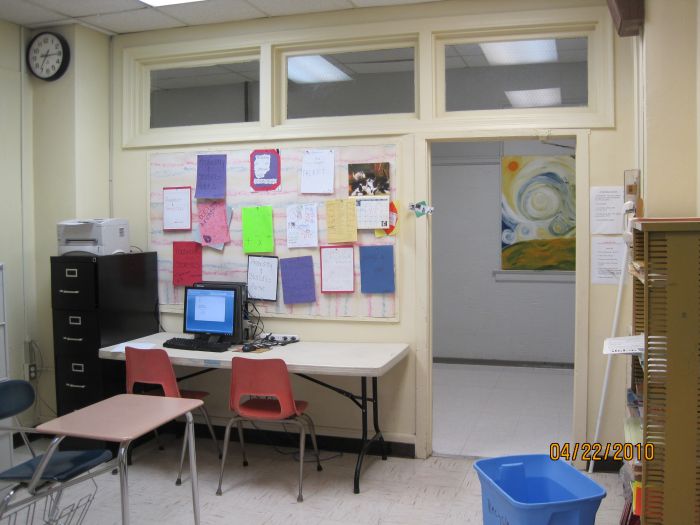
Student work when I was on a long-term sub position

A mixture of colour, song lyrics (from Fireflies by Owl City), and comics

I like throwing in Star Wars whenever I can.

My Pre-Calc students did an activity with unit circles and paper quilts.

Colour, Star Wars, and books!

An example of my classroom from the back at the start of the school year.
Tuesday, October 18, 2011
Teaching Tip #12
Put a Time Limit on Homework
Going over it, that is. Homework shouldn't take longer than 10 minutes - especially if you're like me and let the students go up and put their answers on the board(s) at random. That takes the place of a Warm-Up, in my opinion. Randomness also means all students get a turn, at some point.
Now, there will be times when homework will not take long to go over (yay!) or longer (not necessarily boo).
For example: Today it took almost half an hour for me to go over the homework. Most of my students were having trouble graphing and analyzing their answers, so the longevity of the homework had a sound basis.
If only one or two students didn't understand, however, then that's when I say they need to see me after school.
Again, it's a "know your students and their abilities" way of thinking.
Going over it, that is. Homework shouldn't take longer than 10 minutes - especially if you're like me and let the students go up and put their answers on the board(s) at random. That takes the place of a Warm-Up, in my opinion. Randomness also means all students get a turn, at some point.
Now, there will be times when homework will not take long to go over (yay!) or longer (not necessarily boo).
For example: Today it took almost half an hour for me to go over the homework. Most of my students were having trouble graphing and analyzing their answers, so the longevity of the homework had a sound basis.
If only one or two students didn't understand, however, then that's when I say they need to see me after school.
Again, it's a "know your students and their abilities" way of thinking.
Monday, October 17, 2011
Teaching Tip #9
Display Student Work
Students [usually] love to have their work displayed. If you can't hang things in your room for whatever reason (or if you don't have a room/share it) then there are always the hallways. Here are some things to think about and implement (not all will be used, or used at once).
- Older students tend to be more hesitant about their work being hung up. Ask them if it's okay to hang things up. I had a request from one student to hang nothing but tests and quizzes of theirs up. To me, that's the opposite of most people.
- No matter the age group, don't put anything with a grade up - unless it's within a standard (like all 100s as a coworker does, or all As, or something). One of my worst experiences was that my first failure in 5th grade was on a Social Studies test - which hung in the hall for everyone in grades 3-8 to see.
- Give students the option to hang their work up themselves. This works best with a small class or large room.
- Never tell a student their work can't be hung - unless of course you have one of those standards I mentioned. I don't care how pretty something is, all assignments have the ability to be hung up.
And brag about it! Brag about it at Open House, have a link with various classroom pictures on the school website, tell other teachers (see, more communication), etc. More people will be interested if you do something just a little different.
Students [usually] love to have their work displayed. If you can't hang things in your room for whatever reason (or if you don't have a room/share it) then there are always the hallways. Here are some things to think about and implement (not all will be used, or used at once).
- Older students tend to be more hesitant about their work being hung up. Ask them if it's okay to hang things up. I had a request from one student to hang nothing but tests and quizzes of theirs up. To me, that's the opposite of most people.
- No matter the age group, don't put anything with a grade up - unless it's within a standard (like all 100s as a coworker does, or all As, or something). One of my worst experiences was that my first failure in 5th grade was on a Social Studies test - which hung in the hall for everyone in grades 3-8 to see.
- Give students the option to hang their work up themselves. This works best with a small class or large room.
- Never tell a student their work can't be hung - unless of course you have one of those standards I mentioned. I don't care how pretty something is, all assignments have the ability to be hung up.
And brag about it! Brag about it at Open House, have a link with various classroom pictures on the school website, tell other teachers (see, more communication), etc. More people will be interested if you do something just a little different.
Subscribe to:
Posts (Atom)